
Incorporating Safety into Herbicide Application
Incorporating Safety into Herbicide Application
By Richard Hendler, integrated vegetation management specialist, ACRT Services
Safety is a noun – it’s the condition we work towards. It’s also an adverb, an action word – offering protection from risk. Safety is where we start with all we do – at work and home.
Herbicides are but one tool in our toolboxes. They are a tool that helps us use them more precisely in our efforts to safely provide reliable energy and low-growing, compatible species, and sustainable rights-of-way — when handled and applied safely.
Herbicide safety dates back decades, but there are two individuals who stand out to me: W.C. Bramble and W.R. Byrnes. This duo conducted a study on behalf of the Pennsylvania Game Commission in the 1950s to determine if a new vegetation management tool (synthetic herbicides) were safe for the state’s game, specifically rabbit hunting. This study became the basis for our industry’s foundation of science — all based on a safety concern.
When it comes to herbicides, safety can be as simple as reading the label, following label instructions, and using the proper personal protective equipment (PPE).
The label is the law. The U.S. Environmental Protection Agency (EPA) supervises the initial data package and labeling of all agricultural chemicals. Each state’s Department of Agriculture is then responsible for enforcing and overseeing their use.
The Occupational Safety and Health Administration (OSHA) Hazard Communication Standard requires labels of hazardous chemicals to contain the following.
- Name, address, and telephone number
- Product identifier
- Signal word
- Hazard statement(s)
- Pictograms
I like to focus on the signal word(s) requirement. OSHA states, “Signal words are used to indicate the relative level of severity of the hazard and alert the reader to a potential hazard on the label.” According to the Administration, there are only two words classified as signal words: danger and warning.
- Danger: Used for more severe hazards
- Warning: Used for less severe hazards
As a reminder, there will only be one signal word on the label — no matter how many hazards a chemical may have. Also, as a rule of thumb, all herbicide labels will advise keeping the product out of reach of children.
Safe handling
When handling herbicides, remember this equation. Risk = Toxicity x Exposure. The toxicity of an herbicide cannot be changed, but the risk most certainly can be reduced by preventing or minimizing exposure.
In terms of potential exposure, herbicides can enter the body in three major ways.
- Through the mouth (oral)
- Through the eyes and skin (dermal)
- Through the lungs (inhalation)
The highest risk of potential exposure for those of us in vegetation management is through the skin — specifically without PPE. Think below a long sleeve shirt cuff on the hands, then on the pantleg where you’d rub those hands.
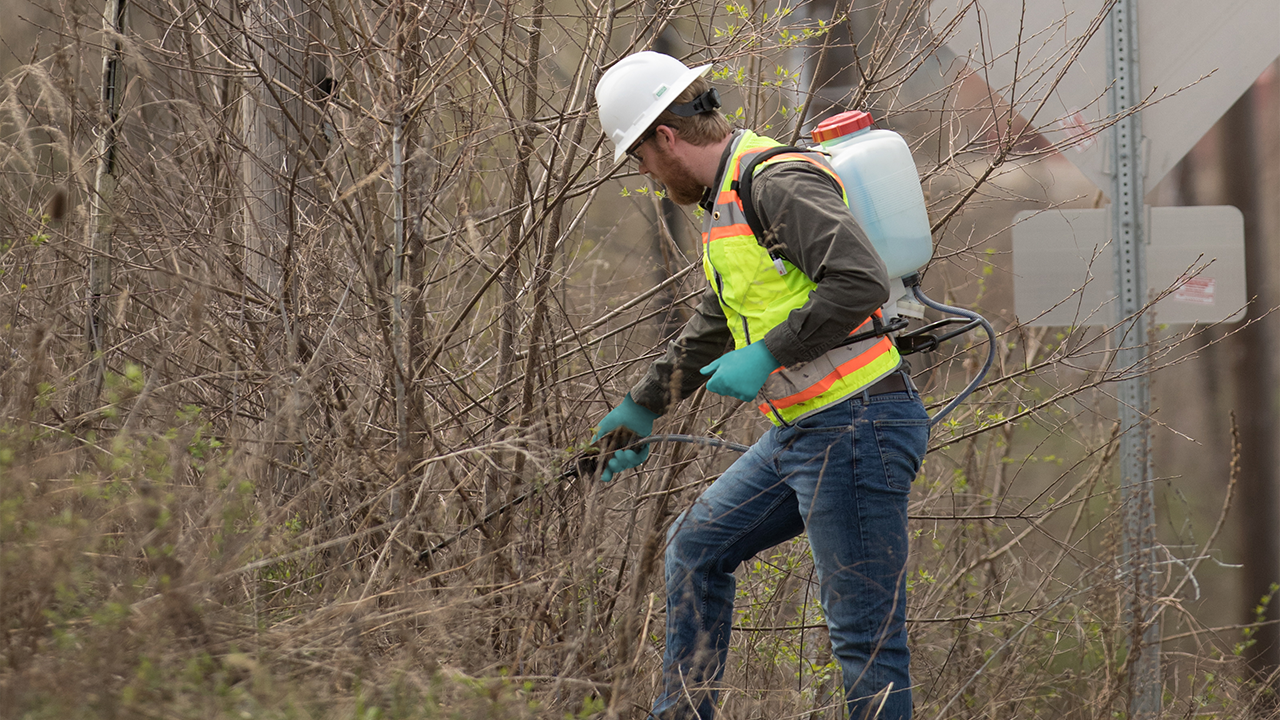
The Pesticide Safety Program at The Ohio State University’s College of Food, Agricultural, and Environmental Sciences recommends donning PPE items such as protective gloves, aprons, respirators, eyewear, footwear, and coveralls. Our line of work applies herbicides that are far less hazardous as compared to all other agricultural chemicals. Typical integrated vegetation management (IVM) herbicide PPE includes long-sleeved shirts, chemical-resistant gloves, safety eyewear, shoes, and socks. It’s also important to keep a clean source of water nearby at all times.
Risk versus risk perception
When a risk is freely chosen, it is usually assumed acceptable. It takes clarity and focus to reasonably balance risk.
Risks = real risk perception = people’s perceptions. The smoker, the drinker, the fast driver, and the person who takes risks. These people all freely choose to act upon those actions, they don’t think or mind if they’re dangerous.
People who are exposed to that, or do not accept those types of risks from people around them, assume risks as unacceptable. We must be aware of the risk perception in our herbicide use and rights-of-way (ROW) applications that cross other people’s properties. It’s important to understand our free choice of risk, along with our care and understanding of how to explain this product and tool use to others who may have a certain risk perception.
Understanding herbicides
It’s easy to visualize the risks involved in mechanical hazards, knowing to act with caution when we use these tools at all times (chainsaws, bucket trucks, giraffes, etc.). There are known safety practices around each of those tools. Like with any other tool, we need to understand and use herbicides safely.
When using herbicides, remember to take the following precautions.
- Wash hands before eating, drinking, chewing gum, using tobacco, or using the toilet.
- Remove clothing immediately if pesticide gets inside. Wash thoroughly and put on clean clothing.
- Remove PPE immediately after handling this product. Wash the outside of the gloves before removing them. As soon as possible, wash thoroughly and change into clean clothing.
If you or a peer swallow or inhale an herbicide or get it in the eyes or on the skin, the United States Environmental Protection Agency (EPA) recommends taking the following actions.
- Call 911 if the person is unconscious, having trouble breathing or having convulsions.
- Check the label for directions on first aid for that product.
- Call the Poison Control Center at 800.222.1222 for help with first aid information.
- The National Pesticide Information Center (NPIC)858.7378 also can provide information about pesticide products and their toxicity.
- EPA’s publication, Recognition and Management of Pesticide Poisoning provides information about symptoms caused by poisoning with specific pesticides and treatment information.
Making safer choices
Incidents occur from irresponsible behavior, unsafe behavior, and cutting corners – we need to keep that in mind.
Do we always use maximum safety and care? The answer is no. Why not? Sometimes it’s casual, sometimes it’s ignorance, or sometimes you’re in a hurry.
There are a lot of different excuses, but what we need to focus on is making better choices, being alert, and remaining focused enough to do what is right.
By recognizing hazards and understanding the tools and equipment used daily, our industry can mitigate risk and work more safely. This is the bottom line when it comes to how we handle herbicides, use herbicides, and are around herbicides.
This article was originally published by Landscape Business.
Related Articles
What Does Quality Really Cost in Utility Vegetation Management? By David Burke, Director of Operations, ACRT Quality is an expectation in utility vegetation management (UVM), but achieving it requires an investment. Training employees, planning work, communicating with customers, inspecting work, and reviewing performance all carry costs. But so do missed vegetation, work that does not[...]
Read More