

Safety Management Systems: More Than Statistics
Safety Management Systems: More Than Statistics
By Adrienne Jones, Safety Manager, ACRT
Every organization wants employees to return home safely at the end of the day. To help achieve that goal, we measure safety performance through a variety of metrics, from incident rates, vehicle accidents, lost-time injuries, near misses, and other indicators designed to help us understand how effectively we’re managing risk.
These measurements provide valuable insight into outcomes and can help identify trends that require attention. However, they also have limitations. By their nature, they are lagging indicators. They tell us what has already happened.
The more important question is often: What could have prevented an incident from occurring in the first place?
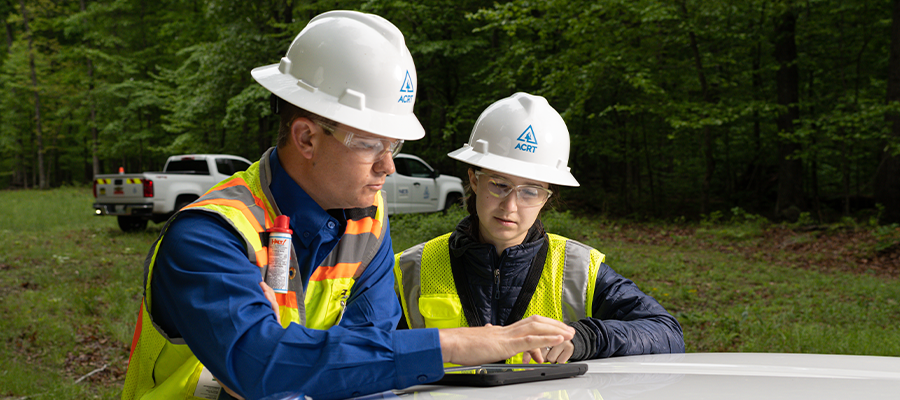
As National Safety Month reminds us, safety is more than a scorecard. It is the result of countless decisions, processes, and actions that occur long before a crew arrives at a job site. The strongest safety programs recognize that safe outcomes are not simply the product of individual behavior. They are the result of systems that identify hazards, establish expectations, support sound decision-making, and create accountability at every level of an organization.
Simply put, safety management systems are the foundation of safe outcomes. Safety is a system, not a statistic.
Safe Work Begins Before the Work Begins
When incidents occur, investigations often focus on what happened at the moment of the event. Yet experienced safety professionals understand that incidents rarely stem from a single action or decision.
More often, they result from a series of conditions that developed over time.
- Was the work properly planned?
- Were hazards identified before work began?
- Did employees receive the training and resources necessary to perform the task safely?
- Were expectations clearly communicated?
- Was there adequate oversight and support?
The answers to these questions often reveal that field personnel are operating within conditions established long before they arrive on-site.
The quality of work planning, resource allocation, scheduling, supervision, and communication all influence the level of risk employees encounter. Crews frequently inherit the systems and processes created by others. When those systems are strong, employees are better equipped to recognize hazards, make informed decisions, and perform their work safely. When gaps exist, risk increases.
This reality underscores an important truth: safety is not owned exclusively by the individuals performing the work. It is a shared responsibility that permeates throughout the organization.
How Safety Management Systems Move Beyond Lagging Indicators
For decades, organizations have relied heavily on lagging indicators to evaluate safety performance. Metrics such as Total Recordable Incident Rate (TRIR), Days Away, Restricted, or Transferred (DART) rates, and vehicle incident statistics remain important tools for understanding outcomes.
However, organizations that aspire to continuously improve safety increasingly recognize the value of leading indicators as well.
Leading indicators focus on activities that influence future performance. They help organizations identify weaknesses before they contribute to incidents and provide greater visibility into the overall health of safety systems.
Examples may include:
- Hazard identification and correction
- Safety observations and field audits
- Training completion and competency verification
- Near-miss reporting
- Corrective action closure rates
- Job brief quality and participation
- Employee engagement and feedback
These measures provide insight into whether safety processes are functioning as intended. They shift the focus from reacting to incidents toward preventing them.
Organizations that monitor both outcomes and the systems that produce those outcomes are often better positioned to identify emerging risks and strengthen performance over time.
Safety and Risk Management Are Inseparable
At its core, effective safety management systems are designed to manage risk.
Every day, organizations make decisions about how work is prioritized, planned, resourced, and executed. Those decisions influence not only operational performance but also employee exposure to risk.
When hazards are identified early, mitigation strategies can be implemented before work begins. When planning processes are thorough, employees can focus on execution rather than uncertainty. When expectations are clear and accountability is consistent, organizations create an environment where safe decisions become easier to make.
The opposite is also true.
Incomplete information, inconsistent oversight, poor communication, or inadequate planning can introduce risk long before work begins. In many cases, what appears to be a safety issue may actually originate as a planning, communication, or process issue.
This is why effective safety programs extend beyond compliance requirements. They are integrated into broader organizational systems that support decision-making, accountability, and continuous improvement.
Safety cannot be separated from operational excellence because both depend on the same foundation: identifying and managing risk before it becomes an incident.
Building a Culture That Supports Safe Decisions
Safety culture is often discussed, but defining it can be challenging.
Culture is not a slogan on a wall or a statement in a handbook. It is reflected in what employees experience every day.
- Do they feel comfortable raising concerns?
- Are hazards addressed when they are identified?
- Do supervisors actively support safe decision-making?
- Are lessons learned shared and applied across the organization?
- Can employees stop work when conditions change without fear of negative consequences?
The answers to these questions often reveal more about an organization’s safety culture than any written policy.
Strong cultures of safety are built on trust, communication, and accountability. They encourage employees to participate in identifying risks and improving processes. They recognize that learning opportunities exist not only after incidents but also through near misses, observations, and routine discussions about work practices.
Most importantly, they create an environment where safety is viewed as a shared responsibility rather than an individual obligation.
Leadership Shapes Safety Performance
While every employee plays a role in safety, leadership has a unique responsibility.
Leaders set the example. They establish priorities. They allocate resources. They set expectations. They determine how organizations respond to concerns, incidents, and opportunities for improvement.
When leaders consistently emphasize planning, accountability, and continuous improvement, they strengthen the systems that support safe work. When operational pressures begin to outweigh safety considerations, employees often receive a different message, regardless of what policies may state.
Effective safety leadership is not demonstrated solely through words. It is demonstrated through decisions.
Investing in training, supporting employees who raise concerns, maintaining consistent standards, showing up in the field, and prioritizing risk management all send a clear signal about what matters most.
Ultimately, leadership shapes the environment in which safety performance occurs.
Safety Is Designed Into the Work
Safety metrics will always remain an important part of organizational performance. They help us understand outcomes, identify trends, and measure progress.
But statistics alone do not create safer workplaces.
Safe outcomes are built through planning, communication, training, oversight, accountability, and continuous improvement. They are the product of systems designed to anticipate risk and support sound decision-making before work begins.
Organizations that focus solely on outcomes risk overlooking the processes that produce them. Those who invest in strengthening their systems create conditions where employees are better equipped to work safely and successfully.
As we recognize National Safety Month, it is worth remembering that safety is not defined by a number on a dashboard.
It is defined by the humans, systems, decisions, and leadership practices that make safe outcomes possible every day.
From Safety Metrics to Safety Systems
The most effective organizations understand that safety is not achieved through policies alone; it is built through systems, accountability, and continuous improvement. ACRT partners with utilities to strengthen the processes, oversight, and risk-management practices that support safer outcomes for employees, contractors, and the communities they serve.
Related Articles


Wildfire Risk & Defensibility: When Risk Becomes Liability By Bob Urban, Senior Account Manager, ACRT Services Every wildfire season raises the same question for utilities: Are we prepared? As wildfire frequency, intensity, and public, investor, and insurer scrutiny continue to increase, utilities face growing pressure to demonstrate not only that they managed vegetation risks, but[...]
Read More